THE WORLD IS MADE TO PLAY. — DISCOVER QIYRO


OEM vs ODM Padel Rackets: Key Differences Explained

When comparing OEM vs ODM padel rackets, brands should also consider private label production. Each approach affects your control over racket design, performance, costs and launch timelines.
The best approach depends on your brand goals, customisation needs and budget.
This guide explains the main options, with a practical focus on OEM padel rackets, customisation decisions and the steps involved in creating your own branded products.
OEM vs ODM Padel Rackets: What About Private Label?
OEM, ODM and private label are different manufacturing routes, not just different names for the same service. In simple terms, OEM gives your brand more control over specifications and customisation, ODM starts from a manufacturer’s existing design concept, and private label is usually the fastest route to branding a ready-made product.
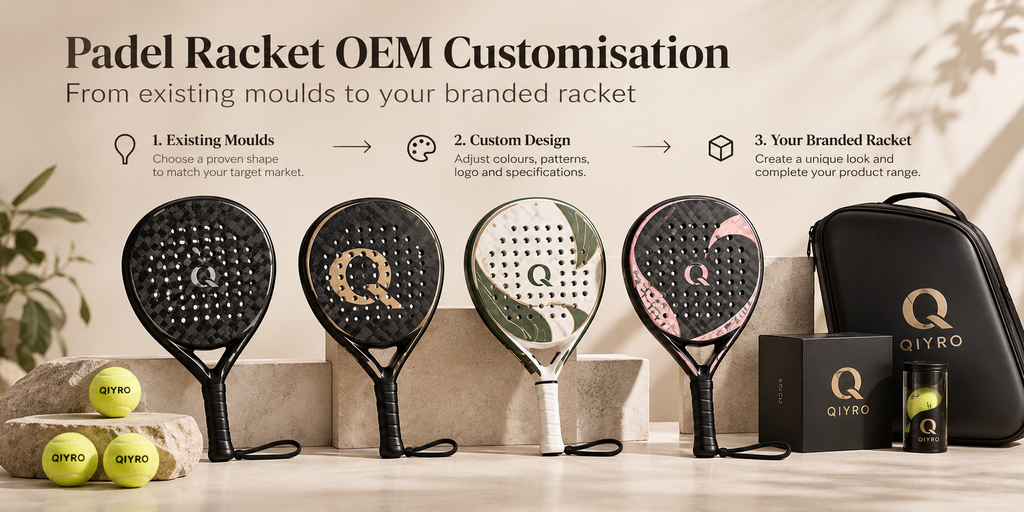
In an OEM project, the racket is produced for your brand based on agreed specifications. These may include racket shape, face materials, EVA core, weight, balance, surface finish, colours, logo placement and packaging.OEM does not always require a new mould. Many brands start with existing factory moulds and customise the materials, construction and appearance to suit their target market.
In an ODM project, the manufacturer provides an existing or largely developed racket design. Your brand can select a suitable model and discuss available adjustments. This approach may reduce the amount of product development required, depending on the supplier’s capabilities.
Private label is usually the most straightforward model. A brand applies its logo, colours or packaging to an existing racket with limited changes to the product itself. It can be suitable for entry-level launches, club merchandise or testing demand, but it offers less room to build a distinctive technical product.
Why OEM customisation is often the right focus for growing brands
OEM customisation is attractive because it helps a brand connect product decisions with real player needs. Instead of simply choosing a finished racket from a catalogue, you can shape the racket around a planned audience: beginners who need comfort, intermediate players who want control, advanced players looking for power, or club players who need a balanced all-round option.
This approach also helps brands create a clearer product story. Two rackets may look similar from a distance, but small choices in face material, core feel, weight, balance and surface texture can change how the racket plays. OEM gives you a structured way to decide what the racket should do before finalising how it looks.
For many projects, the practical route is not “new mould or nothing”. A manufacturer may already have round, teardrop, diamond or hybrid moulds that can support different performance profiles. Your brand can often use one of these moulds as a base and still run an OEM project by customising materials, finish, artwork and packaging. Whether this is possible depends on the manufacturer’s mould library, production process and technical limits.
Key padel racket types and performance choices
A useful padel racket comparison starts with player type, not decoration. Before choosing colours or logos, define how the racket should feel in the hand and what problem it should solve for the player. This keeps the development process focused and avoids building a racket that looks good but does not suit its intended market.
Shape and playing style
Round rackets usually suit control-focused players and beginners because the sweet spot is generally more forgiving. They are often chosen for comfort, consistency and defensive play. If your audience includes clubs, coaches or recreational players, round mould options may be a practical starting point.
Teardrop rackets are commonly positioned as balanced all-round models. They can suit intermediate players who want a mix of control and power without moving too far towards a demanding head-heavy design. For brands building a first performance range, teardrop shapes often provide a flexible middle ground.
Diamond rackets are usually associated with attacking play and more power-oriented positioning. They may feel less forgiving for newer players, especially if combined with a high balance or firmer materials. If you choose this route, be clear that the racket is intended for players who can manage the handling demands.
Face materials: fibreglass or carbon fibre
The face material strongly affects feel, response and market positioning.
Fibreglass is often used where comfort, elasticity and accessibility are priorities. It can be a sensible option for beginner and intermediate rackets, especially when the brand wants a softer playing feel.
Carbon fibre is commonly selected for a more responsive, stable or premium feel. Different carbon constructions may produce different levels of stiffness and feedback, so it is important to discuss available options with the manufacturer rather than treating “carbon” as one single material. A carbon face can support a performance-led product, but it should be matched carefully with the core and target player.
EVA core and impact feel
The EVA core influences comfort, rebound and control.
A softer EVAcan make the racket feel more comfortable and easier to play, which may suit recreational players or those who prefer a more forgiving response.
A firmer EVA can provide a sharper, more controlled feel for players who generate their own power and want a more direct connection to the ball.
The best choice depends on the full construction. A carbon face with a very firm core may feel demanding, while a fibreglass face with a softer core may feel accessible but less precise for advanced players. In OEM development, sampling is important because the real feel comes from the combination, not one specification in isolation.
Specification decisions that define the finished racket
Once the target player and racket type are clear, the project moves into detailed specification. These decisions affect performance, appearance, production feasibility and cost. Not every manufacturer can offer every option, so treat this stage as a technical discussion rather than a fixed shopping list.
Weight and balance
Weight affects handling, stability and fatigue. Lighter rackets may be easier to manoeuvre and more comfortable for many players, while heavier rackets can feel more solid on impact. Instead of choosing a single exact weight too early, brands often discuss an acceptable weight range with the manufacturer.
Balance is just as important. A lower balance can make the racket easier to handle, a medium balance supports all-round play, and a higher balance can add a more attacking feel but may be harder to control. Weight and balance should be considered together because a racket can feel very different depending on how mass is distributed.
Surface finishes
Surface finish affects both appearance and, in some cases, ball interaction. Common options may include smooth, matte, gloss, textured or sand-effect finishes, depending on the factory’s capabilities. A textured surface can support a more performance-oriented message, but it should be selected for realistic function and durability rather than for appearance alone.
Brands should also consider how the finish fits the intended retail environment. A gloss finish can look bright and polished, while a matte finish may feel more understated and premium. The right choice depends on the brand identity, price positioning and the expectations of the target player.
Colours, graphics and logos
Colours and graphics turn the technical product into a recognisable brand asset. Strong racket artwork should be attractive, but also practical for production. Complex gradients, metallic effects or very fine details may require additional checking, adjustment or artwork charges.
Logo placement should be planned carefully across the racket face, bridge, frame and butt cap where applicable. The design must remain clear after printing and finishing, and it should still look balanced when the racket is viewed in play, in photography and on retail shelves. Good OEM artwork is not only decorative; it helps the racket communicate its range, level and personality.
Packaging and presentation
Packaging is part of the customer experience. Depending on the project, options may include branded covers, hang tags, labels, cartons, care cards or retail-ready packaging. For distributors and retailers, packaging also affects handling, storage and shelf presentation.
Before confirming packaging, consider what information the buyer needs. Player level, racket shape, material highlights, weight range and care guidance can all support the sale. As with racket customisation, packaging choices vary by manufacturer and order size, so confirm availability early.
A practical OEM development process
A successful OEM project follows a clear sequence. This helps prevent costly changes late in development and gives both the brand and manufacturer a shared understanding of the final product. The process below is suitable for padel racket brands, clubs, retailers and distributors planning custom padel rackets.
- Identify the target players Define who the racket is for before discussing graphics. Consider playing level, preferred style, comfort needs, price positioning and sales channel. A club beginner racket and a performance retail racket should not be developed in the same way.
- Select the core specifications Choose the intended shape, face material, EVA feel, weight range, balance and surface finish. At this stage, focus on the playing experience first. The clearer your brief, the easier it is for the manufacturer to recommend suitable construction options.
- Review mould options Ask what existing factory moulds are available and whether they match your target racket type. Starting with an existing mould can reduce development complexity compared with creating a new mould, while still allowing OEM customisation in materials, finish, artwork and packaging. If a new mould is required, confirm the technical and cost implications before proceeding.
- Discuss customisation details Review colours, graphics, logos, surface effects and packaging requirements. Share artwork files in the format requested by the manufacturer and confirm whether artwork adjustment, sampling or printing set-up charges apply. This is also the time to check what is technically feasible.
- Produce and evaluate samples Samples help verify playing feel, appearance, weight, balance and finish. Test the racket with players who represent your target audience, not only with internal decision-makers. Record feedback clearly so revisions can be specific.
- Confirm production details Before bulk production, approve final specifications, artwork, packaging, order quantity, quality requirements and expected timeline. Written confirmation reduces misunderstanding and gives the factory a clear production reference.
Commercial planning: MOQs, costs, lead times and checks
Commercial details vary widely by manufacturer and project, so it is better to ask precise questions than to assume a universal answer. Minimum order quantities, development costs, artwork charges, lead times and quality checks can all change depending on mould choice, materials, finish complexity, packaging and order volume.
Minimum order quantities are often linked to production efficiency, material purchasing and printing set-up. A simple private label order may have a different MOQ from an OEM project with custom materials and packaging. If you are launching a new range, ask whether the MOQ applies per model, per colour, per artwork or per total order.
Development costs may include mould-related work, sample production, material testing or special construction requests. If you can begin from an existing factory mould, development may be more straightforward than building an entirely new mould. However, custom specifications can still involve set-up work, so confirm what is included and what is charged separately.
Artwork charges may apply when designs need adjustment, print preparation, colour matching or sample revisions. To reduce delays, provide clear logo files, colour references and layout expectations. It is also sensible to ask how closely production colours can match digital artwork, as screens and physical materials do not always look identical.
Lead times depend on sampling, approval speed, material availability, order complexity and production scheduling. Brands should allow time for review and revision rather than planning only around the factory’s production window. Rushing approvals can increase the risk of mistakes.
Quality checks should cover both appearance and performance-related details. Agree how the factory will check weight range, balance, finish, printing, surface condition, packaging and general workmanship. For larger or more strategic orders, you may also want a pre-shipment inspection or agreed approval samples as a reference.
How should your brand choose between OEM, ODM and private label?
Choose OEM if your brand needs meaningful control over the racket’s specifications, playing feel and visual identity. Choose ODM if you want to work from a manufacturer-developed design with some room for selection or adjustment. Choose private label if speed and simplicity matter more than technical differentiation.
A simple decision framework can help:
- Choose OEM when you have a defined target player, want custom padel rackets, need specific materials or performance characteristics, and are prepared to manage sampling and approvals.
- Choose ODM when you want access to existing product concepts and prefer a shorter development path with moderate customisation.
- Choose private label when you need a branded racket quickly, with limited changes and a simpler approval process.
- Ask about existing moulds in any case, because using a factory mould does not automatically remove the possibility of OEM customisation.
- Confirm feasibility before committing, as options, costs and technical limits depend on the manufacturer, materials, design and order requirements.
The right route is the one that supports your business goal. A new brand may start with a simpler model to test demand, while an established distributor may need a more detailed OEM range covering several padel racket types. There is no single correct answer without understanding the product plan.
Building a stronger racket brief
A good brief helps the manufacturer give better guidance. It should explain the target player, desired performance, preferred shape, material direction, visual style, packaging needs, quantity expectations and launch timing. If you are unsure about technical details, say so clearly and ask for recommendations based on your market.
Include reference points where useful, but avoid asking a manufacturer to copy another brand’s product. The goal is to develop a racket that fits your own positioning. Clear priorities are more useful than a long wish list: decide whether comfort, control, power, durability, price point or visual impact matters most.
It is also helpful to separate “must-have” requirements from “nice-to-have” ideas. For example, a specific weight range and comfortable EVA feel may be essential, while a special surface effect or packaging upgrade may depend on cost and MOQ. This makes negotiation and technical review more efficient.
Final thoughts
The OEM vs ODM decision is really a question of control, speed, complexity and brand differentiation. OEM customisation gives padel racket brands more room to define performance, materials, appearance and packaging, and it can often begin with existing factory moulds rather than a completely new mould. ODM and private label can still be useful routes, especially when the priority is simplicity or faster selection.
If you are planning a new racket range or comparing customisation options, QIYRO can discuss your target players, preferred specifications, mould options and production requirements. Contact QIYRO to explore which approach best fits your racket project and what customisation possibilities may be available for your brand.