THE WORLD IS MADE TO PLAY. — DISCOVER QIYRO
Padel Racket Materials : Fiberglass, Carbon Fiber & EVA

Padel racket materials determine how a racket feels, tolerates repeated impact, supports different player profiles, and fits a brand’s target price point. For padel racket brands, clubs, retailers, and distributors, understanding fiberglass, carbon fiber, EVA, and component interaction makes product selection and OEM/ODM briefing more precise. This guide explains padel racket construction in practical terms so commercial buyers can compare specifications without relying only on marketing labels.
Table of Content
Hide
What do padel racket materials actually control?
Padel racket materials influence the balance between comfort, response, stability, durability, and manufacturing cost. The face material affects ball contact and flex, the frame supports structure and impact resistance, and the core shapes feel through its density and hardness. No single material automatically makes a racket “better”; the right choice depends on the intended user segment, playing style, retail positioning, and quality-control expectations.
Material selection also affects production consistency. Two rackets can both use carbon fiber and EVA, yet feel different because of their layup, resin system, molding process, hole pattern, thickness, weight range, and finishing. This is why material names should be treated as starting points rather than complete specifications, especially when comparing different racket constructions.
The main layers in padel racket construction
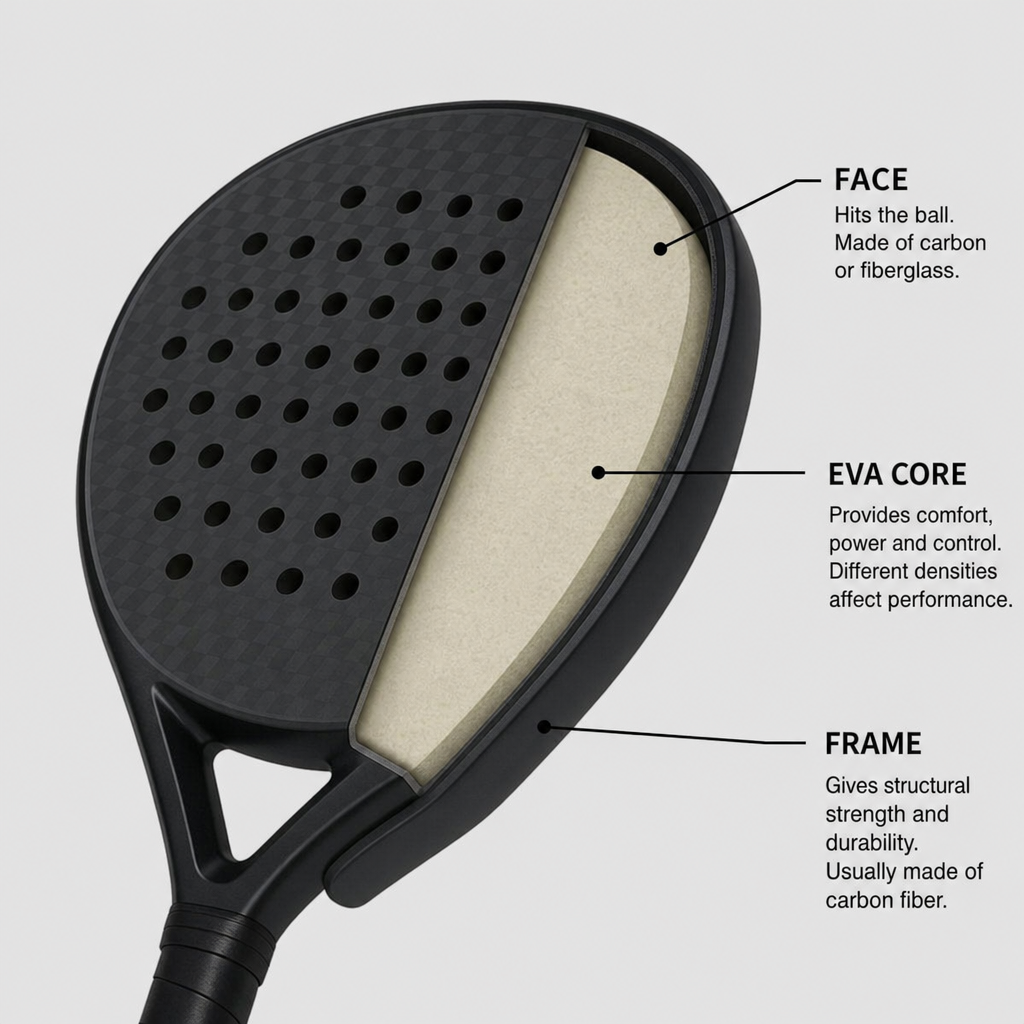
A padel racket is usually discussed in three main zones: face, frame, and core. Each zone has a separate job, but performance comes from the way they work together.
Face materials shape touch and response
The face is the striking surface. Fiberglass and carbon fiber are common choices because both can be laminated into thin, strong composite skins. A more flexible face can feel more forgiving on slower shots, while a stiffer face can feel more direct when the player applies speed. Surface texture, resin content, and layup direction can also influence the playing sensation, so material alone does not tell the full story.
Frame materials provide structure
The frame surrounds the racket and helps maintain shape during impact, twisting, and accidental contact with glass, turf, or another racket. Carbon-based frames are common in many performance-oriented padel racket types because they can provide a stiff structural perimeter at relatively low weight. However, the frame’s real durability depends on material quality, reinforcement design, molding consistency, and finishing protection.
Core materials define feel and rebound character
The core sits between the faces and is commonly made from EVA foam. EVA is valued because it can be manufactured in different densities and hardness levels. A softer core may feel easier to compress and more comfortable for many recreational players, while a harder core may feel firmer and more stable for players who generate their own pace.
Fiberglass vs Carbon Fiber Padel Rackets
Fiberglass and carbon fiber are both composite reinforcements, but they behave differently in padel racket construction.
1) Fiberglass is generally more flexible and cost-efficient, making it common in beginner, intermediate, club, and comfort-focused rackets.
2) Carbon fiber is generally stiffer and lighter for a given structure, making it common in rackets positioned toward advanced players or premium product lines.
The practical difference is not only about “power” or “control.” Fiberglass can help create a softer, more elastic hitting sensation, which may support accessibility and comfort. Carbon fiber can help create a crisper, more solid response, especially when paired with a firmer core or reinforced frame. Many commercial ranges use hybrid constructions to balance feel, cost, and durability.
Understanding Padel Racket Materials
| Material | Structure | General Characteristics | Key Considerations |
|---|---|---|---|
| Fiberglass | Glass-fiber composite | Generally more flexible, with a softer feel in comparable constructions | Final feel depends on resin, layup and EVA core |
| 3K Carbon | 3,000 filaments per tow | Fine fiber bundles that allow different woven constructions | A finer tow does not automatically mean a harder racket |
| 12K Carbon | 12,000 filaments per tow | Larger fiber bundles with different weave characteristics | Stiffness depends on fiber grade, layup and resin |
| 18K Carbon | 18,000 filaments per tow | Larger fiber bundles with a distinctive woven appearance | Higher K does not automatically mean greater stiffness or performance |
| EVA Foam | Internal foam core | Different hardness and density options affect comfort and response | Must be matched with face and frame construction |
| Frame & Reinforcement | Structural materials and internal reinforcement | Influence stability, durability and overall racket stiffness | Final performance depends on the complete construction |
Important: The K rating refers to the number of filaments in a carbon fiber tow, not the hardness of the finished racket. The final playing feel depends on how the face material, EVA core, frame construction, resin, carbon layup and internal reinforcements work together.
Therefore, material selection should consider the intended player profile, playing style and product positioning. The final combination should always be evaluated through finished-racket samples.
What do 3K, 12K, and 18K carbon mean?
In carbon fiber terminology, 3K, 12K, and 18K describe the number of individual carbon filaments in one tow: about 3,000, 12,000, and 18,000 respectively. In padel rackets, these labels often appear on face material specifications, but they do not independently define the racket’s final performance. Layup orientation, resin, layer count, molding pressure, core hardness, and frame design all affect the result.
A 3K carbon fabric uses thinner tows, which can allow a tight weave and a refined visual pattern. It is commonly associated with controlled, precise composite layups, though the final feel depends on the full construction. For OEM buyers, 3K may be appropriate when the design target is a premium face material with a clear carbon identity and balanced stiffness.
A 12K carbon fabric uses thicker tows, creating a different surface look and potentially a different stiffness profile. It is often selected for rackets positioned as firmer or more performance-oriented, but it should be validated with prototypes rather than assumed from the label. Buyers should compare 12K samples under the same shape, core, weight, and balance conditions.
An 18K carbon fabric uses still larger tows and is frequently used where a bold carbon appearance and firm response are desired. However, 18K is not automatically more durable or more powerful in every design. If the face is too stiff for the target user, it may reduce perceived comfort, so it should be matched carefully with the core and player profile.
EVA core hardness and why it matters
EVA core hardness describes how resistant the foam is to compression. In practice, hardness affects the impact sensation, rebound character, comfort, and how demanding the racket may feel. Buyers should request clear hardness specifications from suppliers and test samples across the expected playing temperature range, because foam feel can vary with conditions and manufacturing tolerance.
Soft EVA generally suits rental fleets, club programs, and recreational customers who prioritize comfort and easy ball exit at moderate swing speeds. Medium EVA is often a practical choice for broad retail lines because it can serve a wide range of players without feeling too specialized. Hard EVA tends to suit advanced players or performance lines where a firmer, more connected response is part of the intended product identity.
For B2B assortments, EVA hardness should be planned as part of a range architecture. A distributor may need soft or medium cores for volume models and firmer cores for higher-skill segments. A club shop may prefer materials that reduce barriers for new players, while a specialist retailer may need clearer segmentation by level and playing style.
Materials work as a system
Face, frame, and core materials should be specified together because each component changes how the others behave. A carbon face paired with hard EVA may create a firm and direct feel, while the same carbon face on a softer core can feel more accessible. A fiberglass face over medium EVA may suit all-round play, while reinforced carbon framing can add structural support without making the face excessively stiff.
This system thinking is especially important for durability. A strong face material does not compensate for weak bonding, inconsistent curing, poor edge finishing, or unsuitable drilling around holes. Similarly, a premium carbon label does not guarantee long service life if the frame reinforcement, resin content, or quality-control process is not aligned with the intended use.
For commercial buyers, the main question is not “Which material is best?” but “Which construction best fits the customer, price point, and warranty expectations?” A beginner racket, a rental racket, a junior product, and a high-performance adult racket may all require different material priorities.
OEM/ODM material selection checklist
OEM and ODM buyers should turn material preferences into measurable specifications. This reduces sample ambiguity and helps suppliers quote, prototype, and produce more consistently.
Use this checklist when briefing a manufacturer:
- Define the target user first. Specify beginner, intermediate, advanced, club rental, junior, or performance retail rather than starting with material labels alone.
- Set the face construction. Choose fiberglass, carbon, or hybrid layup, and request details on weave type, layer count, resin, and surface finish.
- Specify the carbon type clearly. If using 3K, 12K, or 18K, confirm whether it applies to the full face, outer cosmetic layer, or selected reinforcement zones.
- Confirm EVA hardness and density. Ask for supplier hardness references, tolerance ranges, and sample consistency across production batches.
- Align frame reinforcement with use case. Rental and club rackets may need impact tolerance and repair expectations considered as strongly as playing feel.
- Test full samples, not swatches only. Evaluate weight, balance, swing feel, sound, comfort, and surface durability in finished rackets.
- Document quality-control criteria. Include acceptable weight range, balance range, cosmetic standards, bonding checks, and packaging requirements.
Range planning for brands, clubs, and retailers
A strong racket range usually gives customers a clear reason to choose one model over another. Materials can support that story when they are used consistently and explained honestly. For example, a brand may position fiberglass and soft EVA as an accessible comfort line, carbon with medium EVA as an all-round performance line, and higher-stiffness carbon with firmer EVA as an advanced line.
Retailers and distributors should avoid overloading customers with technical labels without context. Instead, translate construction into expected user fit: comfort, all-round response, stability, or firmer impact feel. Clubs can use similar logic for demo programs, offering rackets that let players feel the difference between face materials and EVA hardness before buying.
For private-label projects, the safest approach is to build a small, coherent matrix rather than too many overlapping specifications. Clear padel racket types help sales teams explain the line, simplify inventory decisions, and reduce mismatches between player expectations and product feel.
FAQs for material specification
1.Is carbon fiber better than fiberglass for padel rackets?
Carbon fiber is not automatically better; it is generally stiffer and often used in higher-positioned rackets. Fiberglass can be a strong choice for comfort, accessibility, and cost-sensitive ranges.
2.Does 18K carbon mean higher performance than 3K carbon?
Not by itself. 18K, 12K, and 3K describe tow size, while final performance depends on the entire construction, including layup, resin, core, and frame.
3.Which EVA hardness is best for club rental rackets?
Soft to medium EVA is often practical for club environments because it can suit a broader range of players. Durability requirements should still be confirmed through finished-sample testing.
4.Can a racket combine fiberglass and carbon fiber?
Yes. Hybrid constructions are common when a buyer wants to balance cost, flexibility, stiffness, and visual positioning within one model.
5.What should OEM buyers verify before approving production?
They should confirm material placement, finished weight, balance, EVA hardness, cosmetic standard, bonding quality, and batch tolerance. Prototype approval should be based on finished rackets, not only written specifications.
Key Takeaways: Choosing the Right Padel Racket Materials
Padel racket materials are most useful when they are connected to a clear commercial purpose. Fiberglass can support flexible, approachable rackets; carbon fiber can support stiffer and more premium constructions; and EVA hardness fine-tunes the feel that players notice immediately. The most reliable decisions come from matching face, frame, and core materials to a defined user profile, then validating those choices through samples and production controls.
For brands, clubs, retailers, and distributors, a good material strategy makes the range easier to explain and easier to sell responsibly. Treat specifications as a system, keep claims balanced, and require enough detail from suppliers to make each model repeatable at scale.